
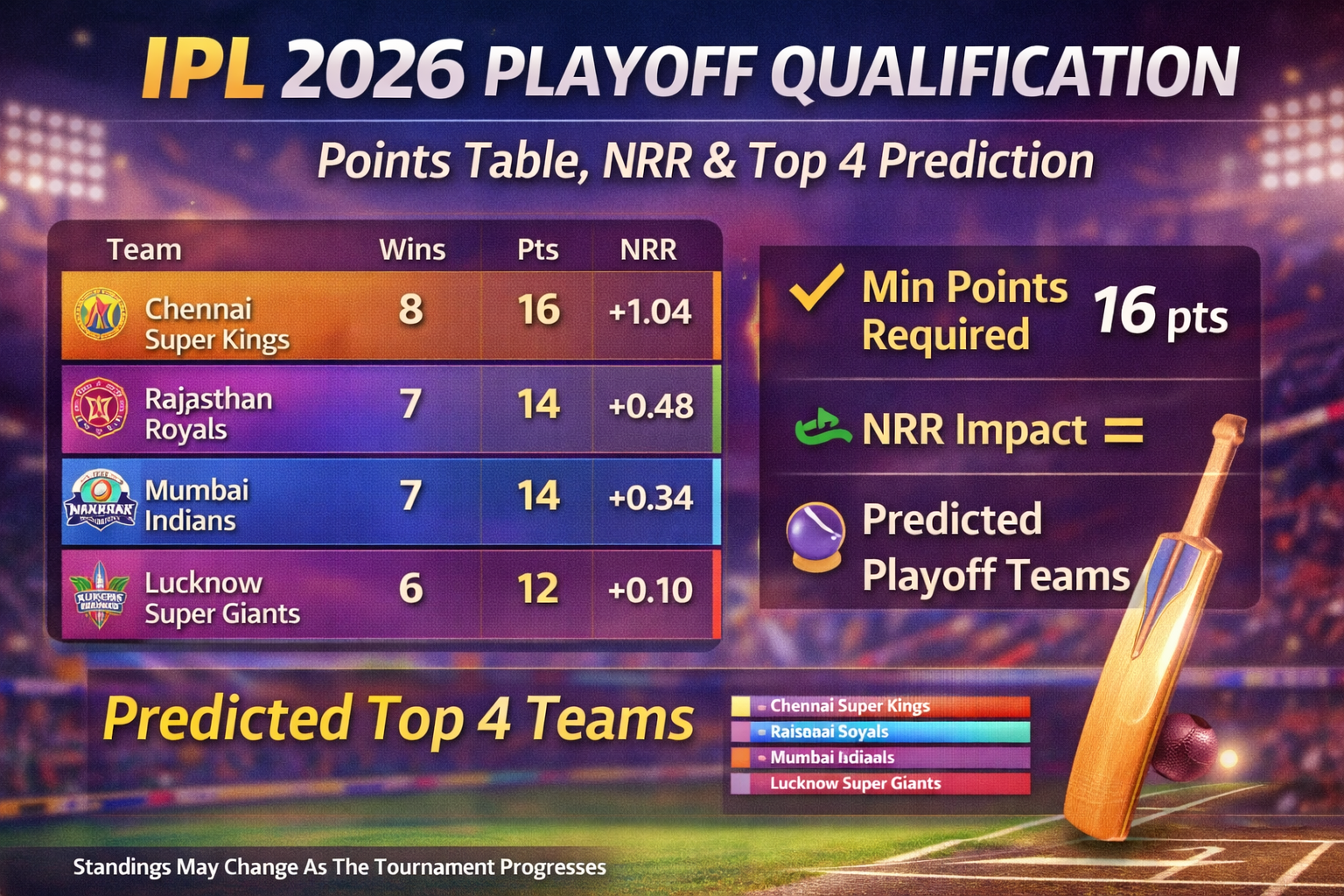
The race to the playoffs in the Indian Premier League is always one of the most exciting parts of the tournament. Every season, teams battle through a long league phase hoping to finish in the top four and secure a place in the knockout rounds. As the competition intensifies, fans and analysts start calculating different scenarios that could determine which teams qualify for the playoffs.
In this analytical guide, we break down the IPL 2026 playoff qualification scenarios using logical projections and the standard points system used in the tournament. Instead of focusing on match summaries, the goal here is to understand how the league table works, what teams need to qualify, and how factors such as Net Run Rate (NRR) influence standings.
The IPL 2026 playoff qualification battle often becomes complicated during the second half of the season when several teams remain mathematically alive in the race. Some teams build strong momentum early and look comfortable in the top four, while others fight for survival in the mid-table. By analyzing points, remaining fixtures, and NRR trends, we can identify the most realistic pathways to the playoffs.
Points System Explained
Before analyzing the standings, it is important to understand how the IPL points system works.
Basic Points Rules
In the league stage of the IPL:
- Win: 2 points
- Loss: 0 points
- No Result / Abandoned Match: 1 point each
- Tie (with Super Over): Winner gets 2 points
Each team plays 14 league matches in the group stage.
The total points accumulated from these matches determine the team’s position in the points table. The top four teams at the end of the league phase qualify for the playoffs.
Role of Net Run Rate
When two or more teams finish with the same number of points, the ranking is decided by Net Run Rate (NRR). NRR is calculated using the difference between a team’s scoring rate and the rate at which it concedes runs.
For example:
NRR = (Runs scored per over) – (Runs conceded per over)
A positive NRR indicates a team scores faster than it concedes, which is usually a sign of dominance.
In the IPL 2026 playoff qualification race, NRR becomes extremely important when multiple teams finish between 14 and 16 points, which is a common scenario in the tournament.
Current Top 4 Analysis
At the midway stage of most IPL seasons, the points table usually starts to reveal which teams are strong playoff contenders. Historically, teams that dominate early often maintain their momentum.
1. Team Leading the Table
The team sitting at the top generally has:
- Strong batting depth
- Reliable bowling attack
- Positive NRR
- Consistency across matches
A team that reaches 16 points early in the season often becomes a near-certain playoff contender.
2. Second and Third Place Teams
Teams ranked second and third usually have:
- Around 12–14 points during the mid-season phase
- Balanced squads with match-winning players
- Good home and away records
These teams still need a few wins but remain in a comfortable position.
3. Fourth Position
The fourth position is usually the most volatile.
Several teams typically compete for this spot with:
- 10–12 points
- Similar NRR values
- Difficult remaining fixtures
Because of this, the IPL 2026 playoff qualification race for the fourth spot often remains open until the final week of the league stage.
Teams Fighting for 4th Spot
The most intense part of the season often revolves around teams positioned between 5th and 7th in the table.
These teams usually have:
- 8 to 12 points
- Multiple matches remaining
- Slightly negative or neutral NRR
Key Factors Affecting Their Chances
1. Remaining Fixtures
If a team still has matches against bottom-ranked teams, it has a better chance of gaining points quickly.
2. Momentum
In T20 cricket, momentum plays a huge role. Teams that win three or four matches in a row often surge into the top four.
3. NRR Recovery
A single large victory can significantly improve Net Run Rate, which can make a difference when teams finish on equal points.
For many franchises, the IPL 2026 playoff qualification battle will depend on how they perform in the final four or five matches.
Minimum Points Required to Qualify
One of the most common questions every IPL season is:
How many points are needed to reach the playoffs?
Historically, the number varies depending on the competitiveness of the season.
Typical Qualification Benchmarks
- 18 points: Almost guaranteed qualification
- 16 points: Very strong chance of qualification
- 14 points: Possible qualification depending on NRR
- 12 points: Rare but possible in unusual seasons
In most seasons of the Indian Premier League, teams targeting 16 points usually feel confident about reaching the playoffs.
For teams currently around 10 points, they typically need to win three of their remaining matches to stay alive in the IPL 2026 playoff qualification race.
NRR Impact Explained
Net Run Rate often becomes the deciding factor when multiple teams finish with equal points.
Why NRR Matters
Consider a situation where three teams finish with 14 points each. Only one of them can take the final playoff spot. In such cases:
- The team with the highest NRR ranks higher.
- Large victories improve NRR.
- Heavy defeats can damage NRR drastically.
How Teams Improve NRR
Teams try to improve NRR by:
- Winning matches by large margins
- Chasing targets quickly
- Restricting opponents to low scores
For example, if a team wins a match by 8–10 wickets or 60+ runs, its NRR can increase significantly.
During the final stages of the tournament, captains often think about NRR while making tactical decisions. This makes the IPL 2026 playoff qualification race even more strategic.
Predicted Playoff Teams
Based on typical IPL trends, squad strength, and consistency patterns, four teams usually emerge as strong playoff contenders.
1. Team A – Strong Title Contender
This team often has:
- Explosive top-order batting
- Experienced bowlers
- Strong finishing ability
Consistency across departments gives them an advantage in the IPL 2026 playoff qualification race.
2. Team B – Balanced Squad
A well-balanced team with quality all-rounders usually performs well across different conditions. These teams maintain stability even when one department struggles.
3. Team C – Momentum Team
Some teams start slowly but peak during the second half of the season. Winning streaks can push them into the top four quickly.
4. Team D – Fourth Spot Survivor
The final playoff spot often goes to a team that wins crucial matches late in the league stage and benefits from a better NRR.
Likely Playoff Scenario
A logical projection for playoff qualifiers often includes:
- Table-top team with 18–20 points
- Second-placed team with 16–18 points
- Third-placed team with 16 points
- Fourth-placed team with 14–16 points
The teams finishing in the top two get an additional advantage.
Playoff Format
- Qualifier 1: 1st vs 2nd
- Eliminator: 3rd vs 4th
- Qualifier 2: Loser of Qualifier 1 vs Winner of Eliminator
- Final: Winners of Qualifier 1 and Qualifier 2
This system rewards teams finishing higher in the table during the IPL 2026 playoff qualification phase.
Conclusion
The IPL 2026 playoff qualification race is shaped by several key factors: points accumulation, Net Run Rate, consistency, and momentum during the second half of the season. Teams that reach 16 points or more generally secure a place in the playoffs, but NRR often determines the final order in the standings.
The battle for the fourth spot is typically the most dramatic part of the league stage. Multiple teams often remain mathematically alive until the final round of matches, which keeps fans engaged throughout the tournament.
Strategic victories, big margins, and strong finishing runs can all play crucial roles in determining which teams qualify for the knockout stage. As the season progresses, every match becomes increasingly important in shaping the final playoff lineup.
Understanding these IPL 2026 playoff qualification scenarios helps fans analyze the tournament beyond individual matches and appreciate the tactical decisions teams make during the league phase.
FAQ Section
How many points are required to qualify for IPL playoffs?
Most teams need 16 points to comfortably qualify for the playoffs. However, in some seasons teams have qualified with 14 points, depending on Net Run Rate and results of other matches.
What role does Net Run Rate play in IPL standings?
Net Run Rate is used as the tie-breaker when teams have equal points. A higher NRR improves a team’s ranking in the points table.
Can a team qualify with 12 points?
It is rare but possible. It usually requires several teams finishing with similar points and favorable NRR conditions.
Why is finishing in the top two important?
Teams finishing in the top two get two chances to reach the final, which gives them a major advantage in the playoff stage.
If you enjoy analytical IPL insights and predictions, follow our blog for more deep cricket analysis, points table breakdowns, and tactical previews throughout the season.
