
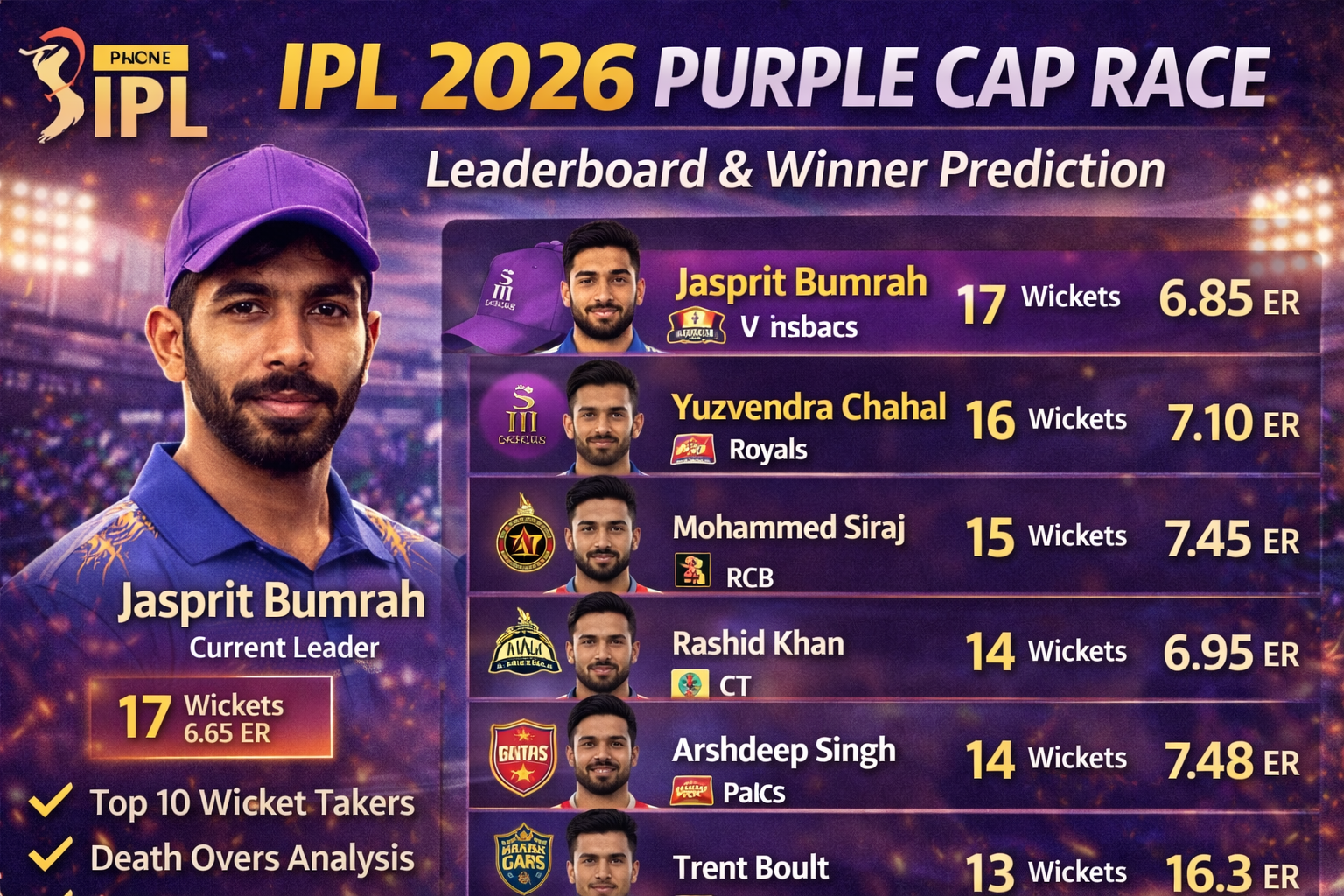
The Purple Cap is awarded to the highest wicket-taker in a single Indian Premier League season. While batters often dominate headlines, bowlers shape the tournament’s outcome just as decisively. A well-timed spell in the powerplay or a clutch over at the death can completely change the direction of a match.
The IPL 2026 Purple Cap race is already emerging as one of the most competitive battles this season. With teams increasingly relying on data-driven matchups, specialized roles like powerplay enforcers and death overs experts have become crucial. Unlike the Orange Cap race, where volume scoring is the primary metric, the Purple Cap often depends on consistency, match situations, and bowling phases.
Current Leader Overview
Jasprit Bumrah – Mumbai Indians
- Matches: 9
- Wickets: 17
- Economy Rate: 6.85
- Strike Rate: 12.7
Bumrah currently leads the IPL 2026 Purple Cap race with a combination of control and wicket-taking ability. What makes his numbers impressive is not just the wickets tally but the economy rate under 7 in high-scoring conditions.
His success comes from:
- Bowling two overs in the death phase
- Accuracy with yorkers
- Variation in pace
Historically, Purple Cap winners average between 20–24 wickets in a season. Bumrah is on track to cross that mark if he maintains this rhythm.
Top 10 Wicket Takers – IPL 2026
| Player | Team | Matches | Wickets | Economy Rate | Strike Rate |
|---|---|---|---|---|---|
| Jasprit Bumrah | MI | 9 | 17 | 6.85 | 12.7 |
| Yuzvendra Chahal | RR | 9 | 16 | 7.10 | 14.2 |
| Mohammed Siraj | RCB | 9 | 15 | 7.45 | 15.0 |
| Rashid Khan | GT | 9 | 14 | 6.95 | 15.5 |
| Arshdeep Singh | PBKS | 9 | 14 | 8.10 | 14.8 |
| Kuldeep Yadav | DC | 8 | 13 | 7.05 | 14.9 |
| Matheesha Pathirana | CSK | 8 | 13 | 7.60 | 13.8 |
| Trent Boult | RR | 9 | 12 | 7.25 | 16.3 |
| Harshal Patel | SRH | 9 | 12 | 8.45 | 15.9 |
| Kagiso Rabada | PBKS | 8 | 11 | 7.90 | 16.0 |
Statistical Insights from the Table
- Strike Rate Matters: Bowlers with strike rates under 15 balls per wicket dominate the leaderboard.
- Death Overs Role: Many top bowlers operate heavily in the 16–20 overs phase.
- Economy Balance: While economy rate is important, Purple Cap winners often sacrifice economy for wickets.
The current IPL 2026 Purple Cap race shows a healthy mix of pacers and spinners, indicating varied pitch conditions across venues.
Death Overs Specialists Analysis
Death bowling has become one of the most defining factors in T20 cricket. Wickets in overs 16–20 often carry greater impact.
Jasprit Bumrah (MI)
- Exceptional yorker accuracy
- Low full toss error rate
- Uses slower balls sparingly but effectively
He has taken 8 of his 17 wickets in the death overs.
Matheesha Pathirana (CSK)
- Slinging action makes him difficult to read
- High percentage of slower deliveries
- Strong under pressure
His strike rate of 13.8 makes him one of the most lethal finish-phase bowlers.
Arshdeep Singh (PBKS)
- Effective wide yorkers
- Can swing the new ball
- High-risk, high-reward approach
Though his economy is slightly higher, he picks wickets at crucial moments.
In the IPL 2026 Purple Cap race, death overs specialists often surge in the second half as teams take more risks while chasing playoff spots.
Best Contenders for Purple Cap
1. Jasprit Bumrah (MI)
Current leader with:
- Strong economy
- High strike rate
- Consistent death overs role
If Mumbai Indians qualify for playoffs, he could gain 2–3 extra matches to extend his tally.
2. Yuzvendra Chahal (RR)
Chahal remains one of the smartest middle-overs wicket-takers. His ability to outthink batters and vary pace gives him sustained impact.
Spinners often peak mid-season when pitches slow down, which could benefit him in the latter stages.
3. Mohammed Siraj (RCB)
Siraj has improved control with the new ball. Early breakthroughs help maintain momentum.
If RCB remain competitive deep into the season, Siraj’s consistent powerplay wickets could push him into the top spot.
4. Rashid Khan (GT)
Rashid’s economy under 7 while picking 14 wickets shows balance. He thrives on pressure situations and can deliver in middle overs when batters attack.
His advantage:
- Low boundary percentage conceded
- Difficult to dominate
Phase-Wise Performance Comparison
| Player | Powerplay Wkts | Middle Overs Wkts | Death Wkts |
|---|---|---|---|
| Bumrah | 3 | 6 | 8 |
| Chahal | 1 | 11 | 4 |
| Siraj | 6 | 5 | 4 |
| Rashid | 2 | 9 | 3 |
This distribution shows how role clarity impacts the IPL 2026 Purple Cap race. Chahal dominates middle overs, while Bumrah leads at the death.
Factors That Will Decide the Purple Cap
1. Playoff Qualification
Extra matches provide more overs and wicket opportunities.
2. Bowling Role Stability
Bowlers who consistently bowl 4 overs per match have higher accumulation chances.
3. Match Context
High-scoring matches increase wicket-taking opportunities because batters take more risks.
4. Fitness and Rotation
Fast bowlers are sometimes rotated to manage workload, affecting total wickets.
Prediction Section
Based on current trends, role clarity, and team momentum:
Favorite: Jasprit Bumrah
Reasons:
- Current leader
- Excellent strike rate
- Plays key overs
- Strong team position
Projected final tally: 23–25 wickets
Strong Challenger: Yuzvendra Chahal
Projected tally: 22–24 wickets
If pitches assist spin in later matches, Chahal could overtake.
Outside Chance: Rashid Khan
His economy ensures he plays every match. If he picks 2–3 wickets in multiple games, he can quickly climb the table.
Final Purple Cap Prediction
At this stage of the IPL 2026 Purple Cap race, Jasprit Bumrah appears slightly ahead due to role importance and consistency. However, the margin is small. One four-wicket haul from Chahal or Siraj can completely shift the standings.
The Purple Cap race historically remains open until the final league week, making sustained performance crucial.
FAQ Section
Who is leading the IPL 2026 Purple Cap race?
Jasprit Bumrah currently leads with 17 wickets.
How many wickets are usually required to win the Purple Cap?
Typically, 22–26 wickets are needed depending on season conditions.
Do spinners or pacers win the Purple Cap more often?
Both have won historically. Role and pitch conditions matter more than bowling type.
Does economy rate affect Purple Cap standings?
No. The Purple Cap is awarded purely based on wickets taken, though economy impacts team selection consistency.
Final Thoughts
The IPL 2026 Purple Cap race highlights how crucial bowlers are in modern T20 cricket. With a balanced mix of pacers and spinners in contention, the race remains open and competitive.
While Jasprit Bumrah currently leads, Chahal, Siraj, and Rashid Khan remain strong challengers. As the tournament progresses toward playoffs, expect rapid changes in the leaderboard.
Consistent overs, defined roles, and team progression will ultimately determine who finishes with the most wickets this season.
Stay tuned for more in-depth IPL statistical analysis throughout the campaign.
